Water still sitting on a commercial roof after surrounding areas have drained gives the facility contact a useful starting point: mark the pond, note its depth if safe to observe, and tell us what lies below. We ask when it appeared, whether the boundary changes after drainage, and who can provide roof access. In Victorville, concentrated rain can expose a low route that stays quiet through dry weather. We map the water, drains, seams, and nearby penetrations before deciding whether the cause is debris, slope, a blocked outlet, or a wider assembly concern.
Victorville gives a two-and-a-half-inch hourly rain rate as a design basis for outlets. It does not confirm what reached this roof or whether its drain can carry the flow. A drain and scupper inspection checks the actual outlet, while a roof-zone map keeps the observed pond tied to the building record.
Water map: mark the boundary before it moves
We record where water remains, how it meets seams and curbs, and whether a drain bowl or scupper is accessible. A shallow pool can hide a depressed area, while sediment lines may show where water has receded. We note the roof surface, nearby repairs, and the interior report without assuming that the two locations align. If conditions are changing, photographs from a safe position and a later observation can show whether water is retreating or returning. The owner gets a map of what was seen at a specific time.
Victorville's Bear Valley Road and I-15 focus area contains regional and local commercial uses in the city's land-use plan. That corridor context does not establish any individual roof's shape, and we do not infer a drainage layout from the neighborhood. We inspect the deck and surface transitions at the property. When water approaches a seam, a seam detail review can address that contact; when a curb interrupts the route, flashing repair evaluates the transition.
Outlet review: clear the path to discharge
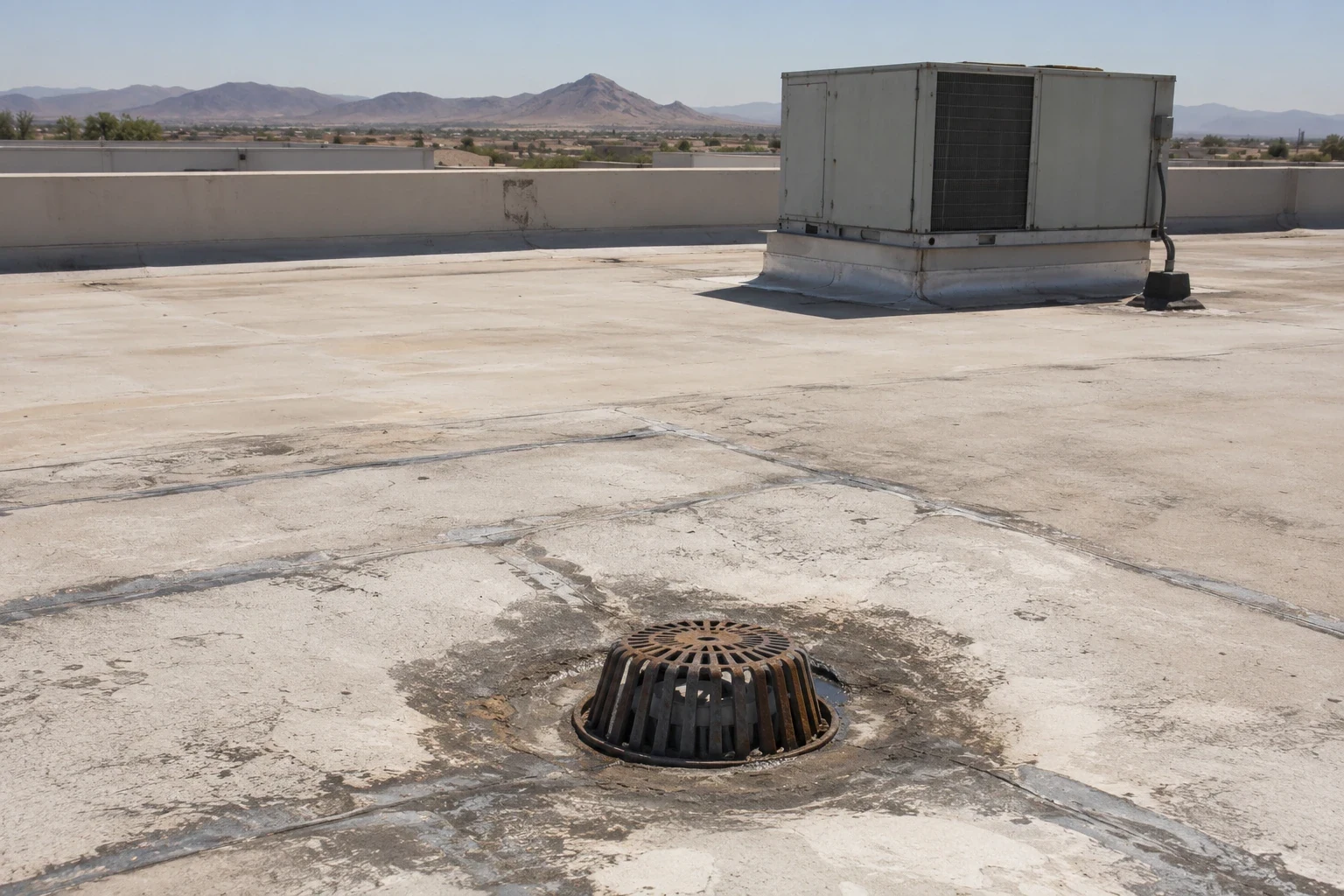
Debris, a loose strainer, a damaged bowl, or a connection problem can slow discharge even where the roof surface appears sound. We check accessible drains, scuppers, overflow openings, and the route that feeds them. Clearing leaves from one bowl does not correct a low deck or a restricted pipe below. The report distinguishes a surface obstruction we can address from plumbing or slope questions requiring another trade. That boundary prevents a drain service from being mistaken for a full drainage redesign.
Interstate 15 and U.S. Highway 395 connect Victorville with regional commercial and industrial corridors, but the useful roof evidence remains at the outlet and waterline. At a property near the city's Seventh Street improvements in Old Town, we still confirm the actual access path, active tenants, and drainage details rather than assign a building type to the district. The photo set records what flowed and what remained, with any plumbing or slope question separated for follow-up.
Assembly check: find what the water has reached
Standing water can keep seams and repairs wet for longer than a sloped area, so we look for softened patches, open laps, displaced ballast where present, surface deterioration, and moisture indicators. We inspect the visible membrane and trace nearby flashing, equipment supports, penetrations, and wall transitions. If an infrared survey or test opening is appropriate, the scope explains what it can answer and where it will be used. We do not treat a wet surface alone as proof that insulation below has absorbed water.
Victorville's climate-code material includes a 5-pound-per-square-foot ground snow load and wind values that vary with occupancy and exposure. Those design inputs do not describe roof ponding; they can matter if drainage corrections change a detail or assembly design. We record current roof conditions and bring structural questions to the appropriate design professional. A broader roof inspection can extend the evidence when concealed material is in question.
Correction options: match the fix to the cause
A repair may clear an obstruction, restore an outlet, rebuild a failed seam, or correct a localized flashing detail. A low area can require a designed slope correction rather than another surface patch. We compare the proposed work with deck condition, insulation, existing layers, drainage route, curb height, and overflow path. If water persists over a broad plane or the substrate is wet, the written scope identifies those findings and explains why a limited patch would leave the underlying issue unresolved.
Cost and timing depend on access, roof assembly, drain connections, material removal, insulation condition, staging, and the weather window needed to tie in the repair. A broader repair or replacement decision follows the moisture and drainage review, particularly if several zones require work. We show the area covered and the open design questions so the facility director can compare a focused fix with a capital project.
Operations: protect the building below
Water over an occupied suite can reach ceiling systems, stored goods, electrical components, or equipment before the drain route is corrected. We coordinate interior protection, access controls, equipment shutdowns, and work windows with the facility contact. If material must be removed, the crew maintains temporary protection and a secure tie-in at the end of each work period. A large facility may need the work divided by roof zone so drainage corrections do not close more of the operation than the scope requires.
Foxborough Industrial Park and planned land east of U.S. 395 and north of Mojave Drive appear in Victorville's industrial-development information. That information is not proof of a completed site or any roof feature; it simply makes delivery and schedule questions concrete for a property manager in the area. We confirm the property's own loading windows and access procedures. Tenant communication stays tied to each roof-zone release and the work window confirmed by the facility contact.
Closeout: record drainage after the repair
The closeout photo set shows the corrected outlet, relevant seams and flashing, and the route from the prior pond toward discharge. We state whether water was observed flowing, what test was performed, and any area not visible or not included. An observation in dry weather cannot confirm performance in every rainfall. The facility contact receives the next inspection point and can compare the same roof zone after a later storm, giving the owner a practical way to see whether the condition has changed.
For commercial roofs in Victorville and the Eastern Bear Valley Road Corridor, we tie drainage work to the actual property, not a broad map label. If persistent water is linked with surface damage, the repair record can distinguish that defect from a drainage issue. A condition report holds the mapped outlet, photos, and follow-up point. Call with the pond location, what happens below it, and the access contact. We can map the water path, inspect the outlet, and define a repair or design question.
Commercial Roofing Questions
How much standing water means the roof has failed?
A photograph or depth measurement alone does not establish a roof failure. We inspect how long water remains, the surface and outlet condition, and nearby seams or flashing, then document whether the cause is visible or needs more investigation.
Does the published drain-sizing rate prove a drain is undersized?
No. Victorville's published rainfall input is a design reference. We check the installed outlet, accessible piping, overflow path, and roof conditions, then identify any sizing or engineering review that remains.
Can you repair a low spot without replacing the roof?
Sometimes. A localized correction may work when the deck, insulation, drainage route, and surrounding membrane support it. We inspect those conditions first and explain when a design change or broader scope is needed.
Should we pump water off the roof before you arrive?
Do not send staff onto an unsafe roof or use equipment without an approved safety plan. Tell the facility contact where the water sits and what is below it. We will assess safe access and whether immediate protection is appropriate.
What should the closeout report show?
It should identify the prior pond boundary, outlet and overflow condition, work completed, photos, and any untested piping or slope issue. We also note the roof zone to compare after a later rain event.